Deadlands
The Calamitous BobThe Deadlands are the poisoned western expanse of Param, a region created by the Old Empire’s catastrophic magical collapse and sustained afterward by black mana and the undead. Their decisive significance is that they are not merely a haunted ruin: they are a self-maintaining ecological and political wound, separating the living world from the remains of an imperial civilization while forcing travelers, soldiers, and kingdoms to adapt around a disaster that no longer belongs to any single generation.
Definition and Physical Setting
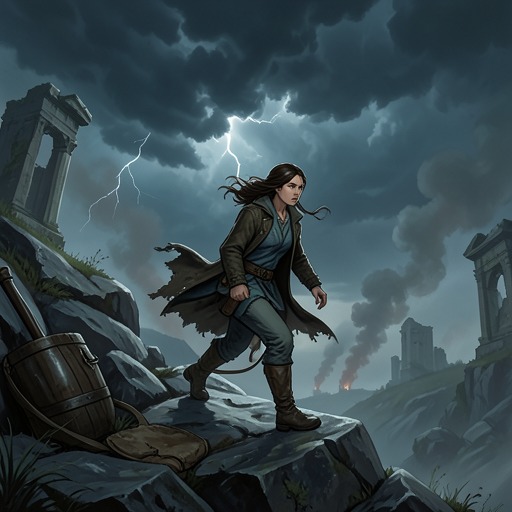
The Deadlands occupy the western part of Param, a large circular landmass connected to its only neighboring continent by an isthmus no wider than a city. From above, the catastrophe’s mark resembles necrotic tissue on an otherwise healthy body. A vast valley lies inside snow-capped mountain ranges, with only a small southern gap, and the land grows less dark and more greenish as it recedes from the epicenter. The terrain is cold, dry, dusty, and desolate; later views show gray earth, black stumps, ruined towers, stone mounds, ravines, and seemingly endless tundra.
At the center stands the ruined capital of Harrak and the enormous Imperial Ziggurat. The city was once the seat of the Old Empire, whose elites reached unprecedented heights of magical ability before creating their own destruction. Only one expedition is known to have successfully explored the old capital, reporting empty streets dominated by the ziggurat’s immense remains. The building is described as a mighty cadaver gutted by an explosion, while the surrounding city has been reduced to a crater as large as a volcano. Rubble the size of apartment buildings lies across the basaltic desert, and the vitrified, molten edges of the central crater suggest a force comparable to an asteroid impact or tactical nuclear detonation.
The Ruined Imperial Heartland
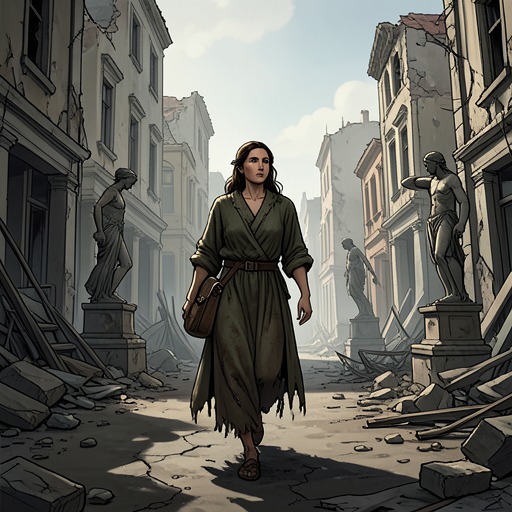
The Deadlands preserve the contradiction at the heart of the Old Empire: the civilization’s greatest achievement and its final disgrace occupy the same space. Harrak’s carefully planned avenues, estates, temples, churches, and squares still extend for kilometers, but they are dark, dead, and devoid of movement. The precision of the urban plan survives only as the architecture of abandonment. Beyond it, mountains recede into the distance, while the shattered remains of the imperial center lie scattered as if a titan had thrown them across the land.
The region therefore operates as a cautionary monument. The Old Empire died at the apex of its power, and its surviving legacy is limited to private collections and the languages of kings. Its former capital is no longer a political center but a corpse inhabited by mindless undead. Necrarchs cover the exposed ground around the imperial crater in grotesque multitudes, turning the site of centralized magical authority into a visible consequence of uncontrolled magic.
Survival Conditions and the Black-Mana Field
The Deadlands are hostile not only because of their monsters but because ordinary forms of survival have failed there. Viviane Saint-Lys concludes that the camps she encounters were established despite the abundance of buildings, indicating that the region receives no rain. The available shelter would have been sufficient for protection from undead, so the decision to camp outside it implies that rainfall is effectively absent. The land also lacks renewable food: Viviane Saint-Lys cannot recall seeing even a dried patch of grass, and the surrounding environment offers no dependable source of sustenance.
As she travels south toward the mountain gap, the black mana gradually weakens. From a plateau she can see hints of salvation beyond the range: a dense, imposing forest that is visibly green and alive. The transition is not immediate. The plains remain dotted with dark shrubbery and zombies even as the black mana fades, making the southern opening both a geographical exit and a threshold between two ecological regimes. After reaching the living forest, Viviane Saint-Lys experiences ordinary grass, loam, sap, and temperate deciduous trees as remarkable signs of recovery after prolonged exposure to the Deadlands.
The region’s apparent boundary is also deceptive. Revenants become rarer near the edge, and many begin walking back toward the Deadlands, but the danger does not simply disappear. A horde can still appear as a distant point before revealing itself as a purposeful mass of larger undead forms covered with revenants. The advancing group sheds slower specimens along the way, leaving a trail as it moves directly toward its target. The Deadlands thus produce threats that behave less like isolated monsters than like migrating, self-organizing concentrations of death.
Equilibrium and Political Containment
The Deadlands have reached an equilibrium in which the undead maintain the conditions that sustain them. Cernit explains that the monsters generate a black field of their own, so reducing the region’s black-mana density would require several large-scale expeditions capable of killing enough undead to make a meaningful difference. No kingdom is willing to commit those resources to land regarded as worthless, particularly when more accessible regions can be developed instead. Recovery would take decades even after a successful intervention.
This calculation places the Deadlands within a wider network of frontier politics. The region lies in the Harrakan heartlands, marked on a map with a skull, while Baran occupies the far eastern part of Param and Kazar belongs to the local kingdom of Enoria. The political landscape between them contains several other countries and many smaller territories. The Deadlands are therefore not an isolated wilderness outside history; they are the abandoned core around which later kingdoms, roads, forts, and military patrols organize their risk.
Fort Stone’s fall demonstrates the strategic consequences. Its distant alarm signal and subsequent smoke indicate that powerful undead or a necromancer may have breached it. Patrols from Fort Sky search for the rogue caster because a fallen fort can allow undead to swarm over defensive walls, leaving the living with little hope of warning or assistance. What the patrol finds instead is a trail of dead revenants, evidence that movement through the Deadlands can carry violence outward into the defended world.
Borderland, Passage, and Narrative Significance
For Viviane Saint-Lys, the Deadlands are first a place of immediate deprivation: she must leave because monsters, hunger, thirst, and the absence of renewable life make remaining there fatal. The journey south becomes a prolonged negotiation with the region’s geography, its black mana, and the undead populations produced by the catastrophe. Solfis’s silence after leaving Harrak suggests that the ruined capital is not merely scenery even to a being created in another age; the Deadlands preserve a grief associated with the destruction of the civilization that made him.
The region also exposes the uneven survival of history. Its imperial roads and monumental architecture remain, but the institutions that once controlled them are gone. Modern powers map the Deadlands, patrol their borders, and make practical decisions about abandoning them, while travelers depend on way-houses and local protection to cross the surrounding frontier. The ruined heartland has become a limit that kingdoms manage rather than conquer.
Its strongest contrast is with the Cassian Spring and the living forest beyond the southern gap. The spring emerges when Cassia the Unbroken dies after a long and fulfilling life, and its waters retain Neriad’s blessing. Against that image of death giving rise to protected, enduring life, the Deadlands show death reproducing itself through black mana and undead equilibrium. The juxtaposition makes the region more than a symbol of destruction: it is one possible afterlife of a world, while the spring represents another, in which sacrifice and memory allow renewal.
As a setting, the Deadlands combine gothic ruin, ecological disaster, and imperial aftermath. Their dead cities and impossible crater make suppressed history physically unavoidable; their undead field turns magical catastrophe into a continuing material process; and their southern border gives the plot a concrete threshold between extinction and recovery. The place remains dangerous precisely because it has stabilized. Nothing needs to happen for the Deadlands to persist: the catastrophe has become an environment, and the living must build their lives around it.